

Tuber suaveolens Ant. Rodr. & Morte
Persoonia 47: 365 (2021)
Etymology:
Referring to its mild odour.
Macroscopic characters:
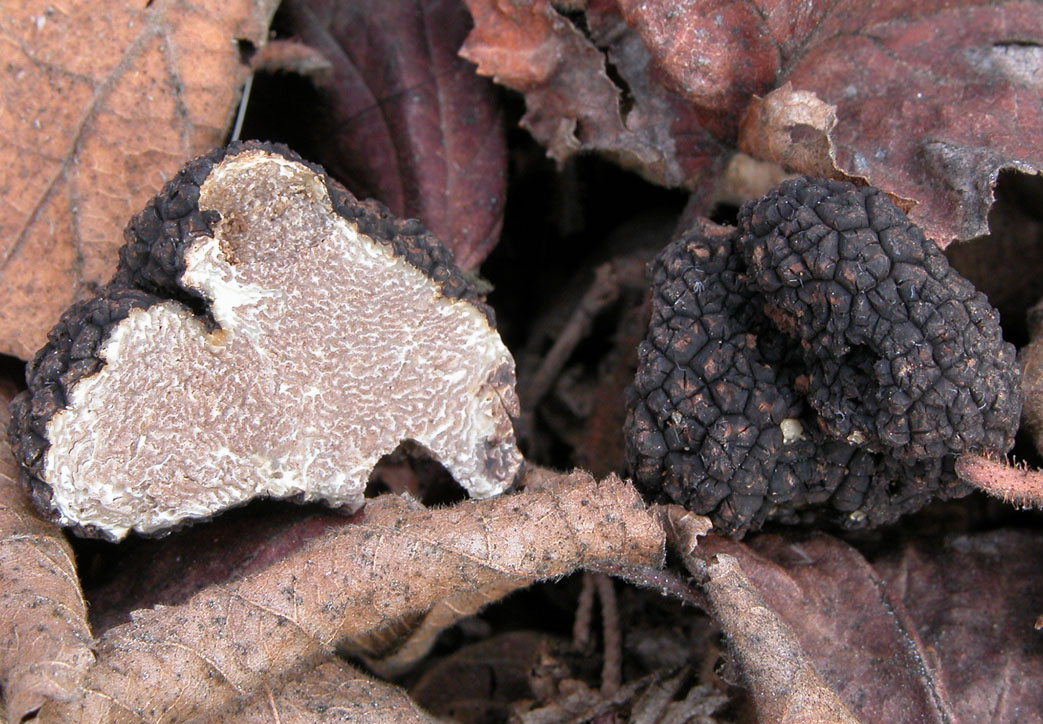
Ascomata: hypogeous, 1–3 cm, subglobose, sometimes with a rudimentary basal cavity, covered with brown-black pyramidal warts, 4–6-sided, 2–4(–5) mm across, 1–3 mm high, often depressed at the apex.
Peridium: 150–300 μm thick, pseudoparenchymatous, composed of subglobose, angular cells, 10–20 μm diam., dark red-brown and thickened walls in the outermost layers, pale yellow and thin-walled in the innermost layers, merging with interwoven hyphae of glebal tissue.
Gleba: firm, solid, white when immature, becoming dark brown at maturity, marbled with numerous, thin, white, meandering veins.
Odour: mild phenolic. Taste: bitter.
Habitat:
Tuber suaveolens grows in calcareous soil of limestone mountains of the southeast of the Iberian Peninsula, associated with Quercus spp. in winter.
Notes:
Tuber suaveolens is a black truffle of the aestivum clade, characterised by its brown-black warty peridium, brown gleba marbled with thin white veins, mild phenolic odour and reticulate-alveolate spores. It resembles T. mesentericum, but in addition to genetic differences, T. mesentericum (Vittadini 1831) has a strong phenolic odour, a well-developed basal cavity and a different vein arrangement. It also resembles T. alcaracense, but T. alcaracense has a pleasant odour and lacks a basal cavity (Crous et al. 2020). Tuber suaveolens should not be confused with Tuber suave Pacioni & M. Leonardi, despite their similar name and morphology. Both species belong to the T. mesentericum complex but cluster in different subclades (subclades II and III respectively), with an ITS divergence well above the species delimitation threshold accepted for the genus Tuber.
Microscopic characters:
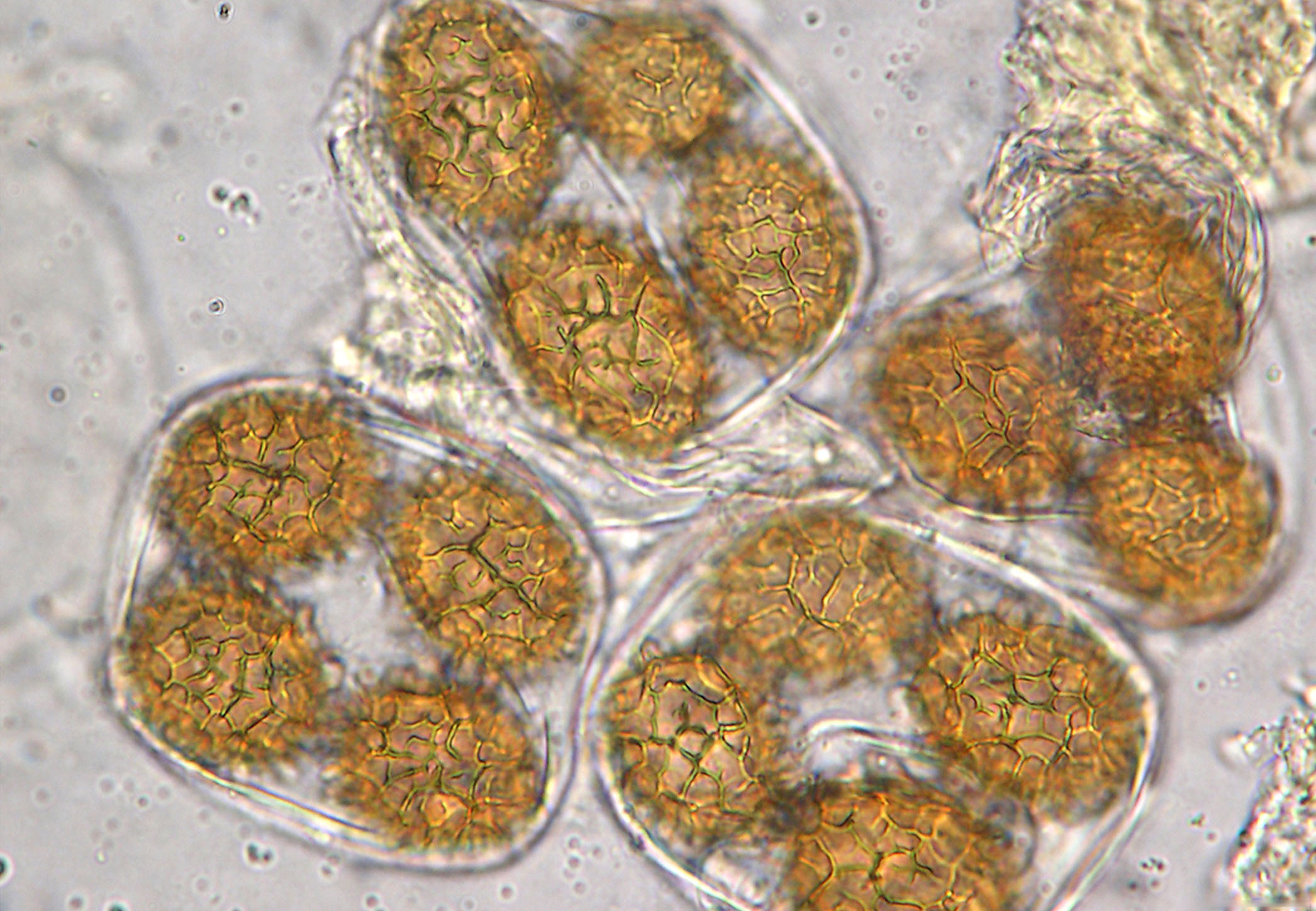
Asci: inamyloid, 50–90 × 50–70 μm, walls 1–2 μm thick, ellipsoid to subglobose, with a short stalk, 10–30 × 5–7 μm, 1–5(–6)-spored.
Ascospores: 25–55 × 25–37 μm, Q = 1.1–1.4, excluding ornamentation; yellowish, ellipsoid to subglobose, ornamented with a coarse irregular reticulum, 3–5 μm high, sometimes bending at the top; meshes variable, usually 3–5 across the width of the spore, often with incomplete secondary crests inside.
Phylogenetic analysis:
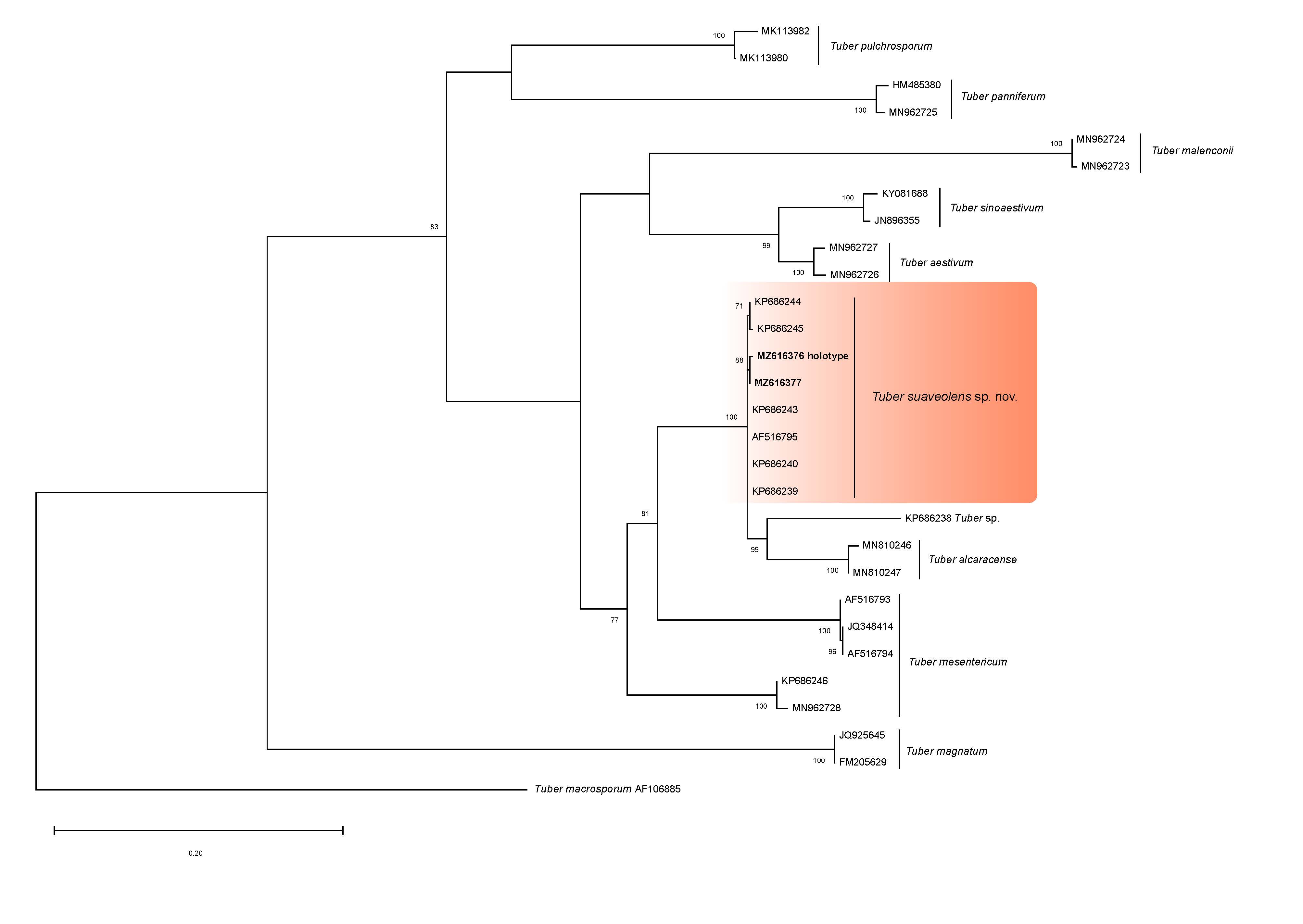
Maximum likelihood (ML) phylogenetic tree inferred from ITS sequences, using RAxML-HPC v. 8 (Stamatakis 2014) on XSEDE in the CIPRES Science Gateway (Miller et al. 2010). GTR + G was selected as the model of evolution for the analysis. The sequences obtained in the present study are highlighted in bold and the novel species with a coloured box. Bootstrap support values (≥ 70 %) are indicated at the nodes. Tuber macrosporum AF106885 was used as outgroup. The scale bar indicates the expected number of changes per site.
 |
Antonio Rodríguez trufamania@gmail.com antonio@trufamania.com ORCID iD: 0000-0002-0708-7773 |