

Tuber lusitanicum Ant. Rodr. & Muñoz-Mohedano
Persoonia 45: 395 (2020)
Etymology:
Referring to Lusitania, the name given by the Romans to the western region of the Iberian Peninsula, which now covers the Portuguese area below the Douro river and the neighbouring regions of Spanish Extremadura.
Macroscopic characters:
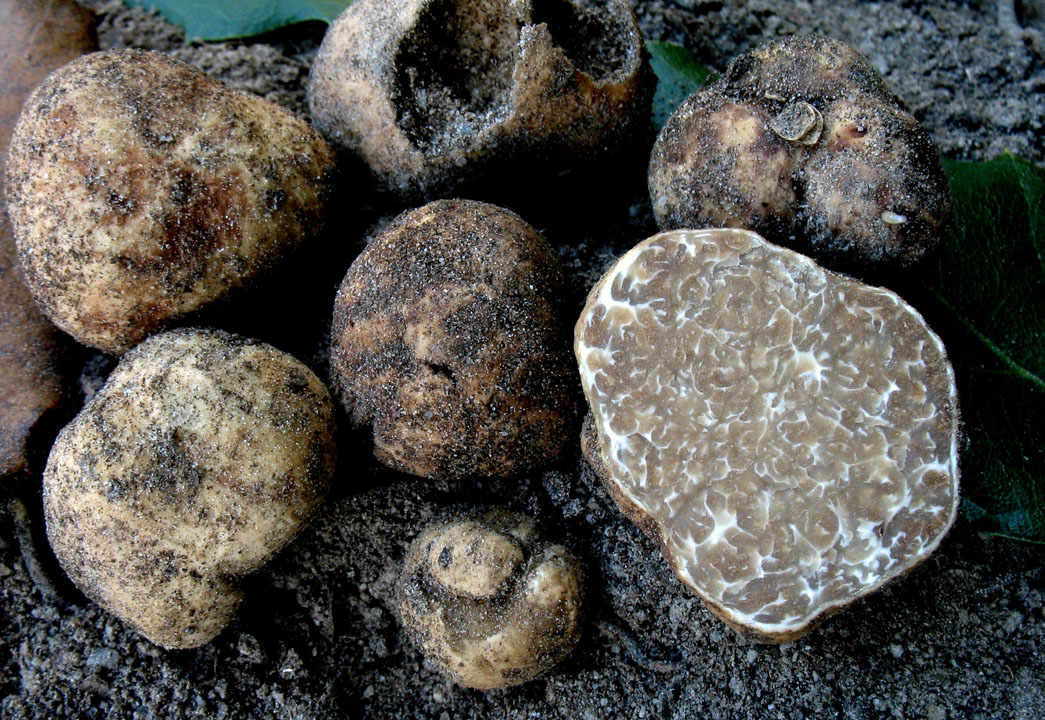
Ascomata: hypogeous, 0.5–2 cm, subglobose, often lobed or irregular, solid, firm, white at first, becoming white-cream, pale yellowish, sometimes with a reddish tinge, darker at maturity, smooth.
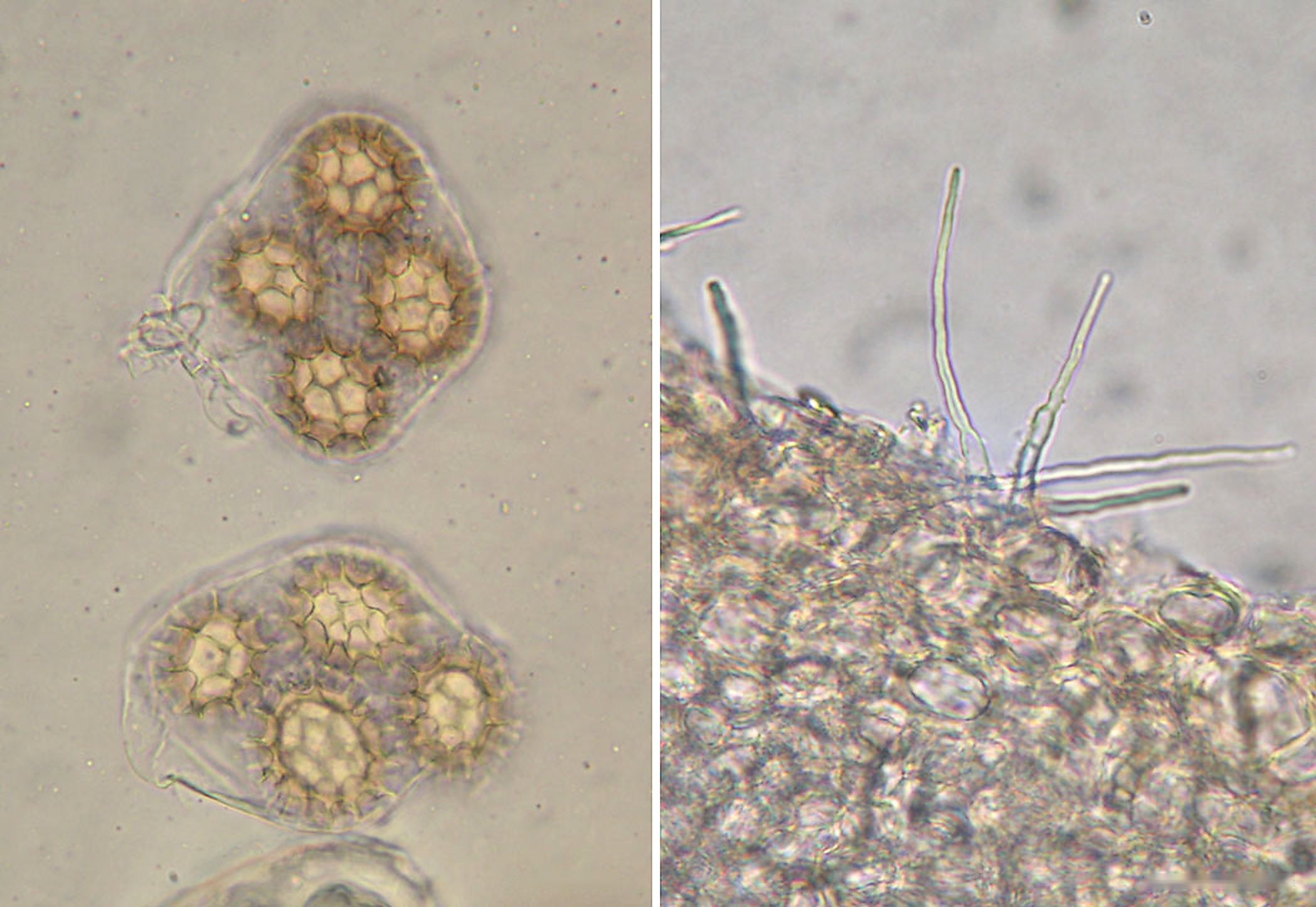
Peridium: 300–500 μm thick, two-layered; outermost layer pseudoparenchymatous, composed of subglobose or subangular cells, mostly 10–20 μm diam., yellowish, thick-walled, giving rise to hairs at the surface; inner layer composed of hyaline, thin-walled, interwoven, broad hyphae gradually intermixing into the gleba.
Hairs: sparse, commonly 40–60 × 3–5 μm, hyaline, slender, tapered, setose, thick-walled, sometimes 1-septate near the base.
Gleba: whitish when immature, becoming olive brown to dark brown at maturity, marbled with numerous, thin, white veins, some veins ending in the peridium.
Odour: slight and not distinctive.
Habitat:
Tuber lusitanicum grows in acidic soils of Extremadura dehesas associated with Quercus spp. in spring. Currently known only from Cáceres, Spain.
Notes:
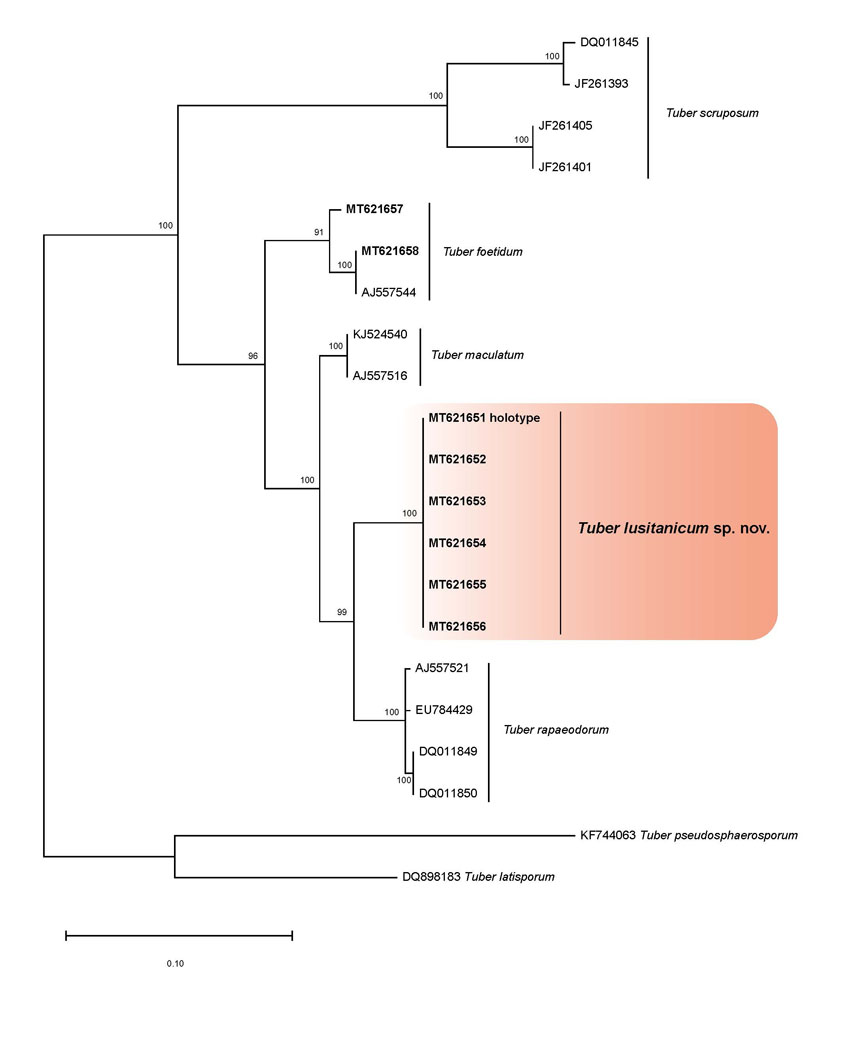
Tuber lusitanicum is a whitish truffle that clusters in the maculatum clade, and is characterised by its white-cream smooth peridium, brown gleba marbled with numerous, thin, white veins and reticulate-alveolate spores. Tuber lusitanicum is a sister species to T. rapaeodorum (88 % similarity of ITS sequence), but T. rapaeodorum differs by having larger, narrower spores and a thinner peridium (Ceruti et al. 2003). It also resembles T. maculatum (74 % similarity of ITS sequence), but T. maculatum has a prosenchymatous peridium, lacks hairs and has larger spores (Mello et al. 2000).
Microscopic characters:
Asci: inamyloid, 50–80 × 50–60 μm, thin-walled, ellipsoid to subglobose, sessile or short-stalked, (1–)3–4(–5)-spored.
Ascospores: 19–35 × 17–28 μm, Q = 1.1–1.3, excluding ornamentation; walls 2 μm thick; at first hyaline, becoming yellowish brown at maturity; subglobose to broadly ellipsoid, ornamented with a regular reticulum, alveoli 3–6 μm tall, 6–10 μm long, 2–5 alveolar meshes along the spore length, polygonal (5–6 sides).
Phylogenetic analysis:
Maximum likelihood (ML) phylogenetic tree inferred from ITS sequences, using RAxML-HPC v. 8 (Stamatakis 2014) on XSEDE in the CIPRES Science Gateway (Miller et al. 2010). GTR + G was selected as the model of evolution for the analysis. The sequences obtained in the present study are highlighted in bold. Bootstrap support values (≥ 70 %) are indicated at the nodes. Tuber latisporum and Tuber pseudosphaerosporum were used as outgroup. The scale bar indicates the expected changes per site.
 |
Antonio Rodríguez trufamania@gmail.com antonio@trufamania.com ORCID iD: 0000-0002-0708-7773 |